
Unexpected Joy
What a strange name for an icon.

Here’s an unusual icon:
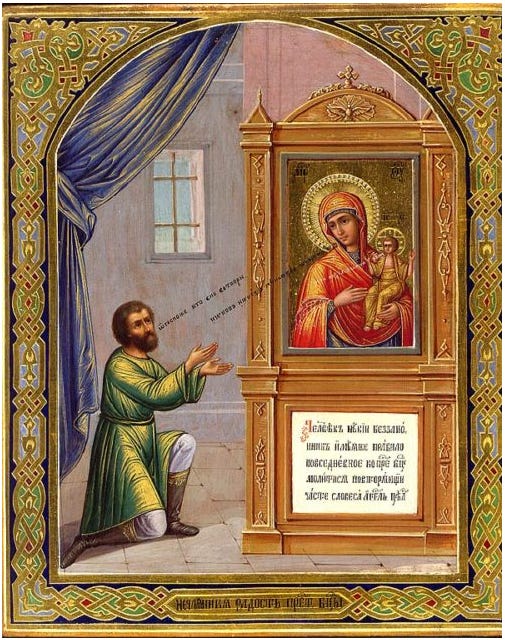
We are inside a room in this young man’s house. He is a confirmed sinner, going out every day to commit more outrage and injustice. And yet he loves the Virgin Mary Theotokos, and has set up a life-size shrine in his house. Every day he kneels before the icon and prays, then heads out to commit more crimes.
One day, to his horror, the image comes to life. The Theotokos turns her face toward him. The Child Jesus holds up his hands—and the man sees that they are pierced with fresh wounds, flowing with blood.
He recoils in horror. “Who has done this?” he exclaims.
The Theotokos replies, “You have done it, you and other sinners, who crucify my Son anew.”
(You can see these lines of dialogue extending from each of them to the other.)
The man is stricken in conscience, recalling all the evil he has done. He begs to be forgiven. And now we see words in white proceeding from Christ to the penitent man: “Your sins are now forgiven.”
And so this icon is called “Unexpected Joy.” But it still seems a surprising name for what just happened. The young man was horrified at what he saw, and aghast at the relentless effects of his sins. This isn’t “Have a good time” kind of joy. It’s the joy of receiving mercy, forgiveness, and love, when you know so deeply that you don’t deserve it.
I think it’s hard for people in our time to get to that level of penitence and humility. We have so many excuses for the things we do, so many reasons why we deserve to be indulged. Advertising keeps catechizing us on our obligation to seek nonstop pleasure, eat and drink in great quantities, buy things we can’t afford, and meet our obligation to cooperate with the endless consumerist festival. We don’t feel the joy, because we don’t feel the repentance.
Yet this was the central concept of Christianity for most of history: Christ came for sinners, not the righteous (Luke 5:32), and when we recognize and admit our sinfulness, we are rescued and redeemed. Joy indeed.
This is a strange, inexplicable icon for people of our time. But the more you can apply it to yourself, the more joy you will unexpectedly discover.
I wrote a prayer that I read when I go to confession; I felt like I needed a way to sum things up. Maybe you’ll find it useful too.
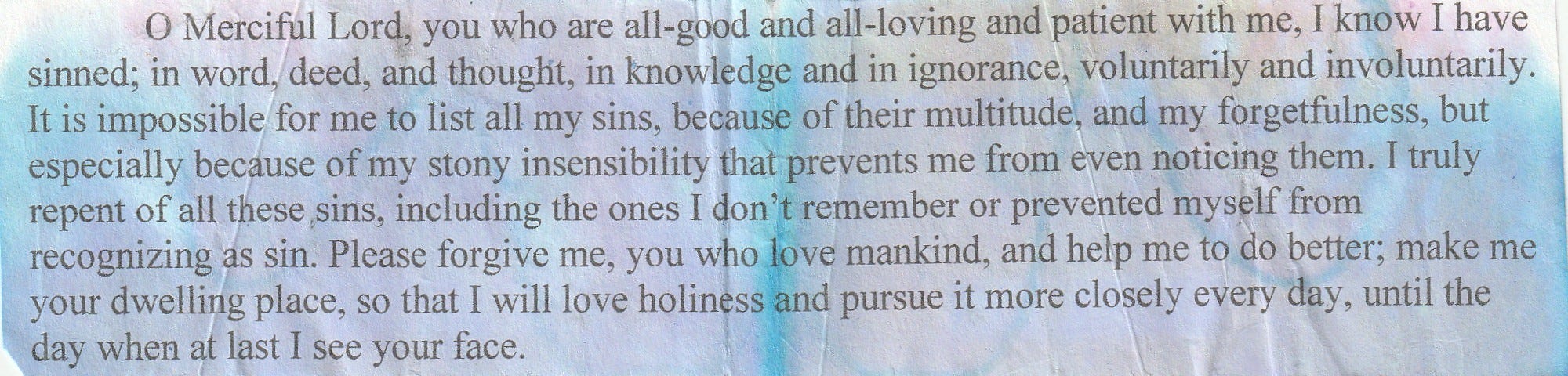
FMG Confession Prayer
O Merciful Lord, you who are all-good and all-loving and patient with me, I know I have sinned; in word, deed, and thought, in knowledge and in ignorance, voluntarily and involuntarily. It is impossible for me to list all my sins, because of their multitude, and my forgetfulness, but especially because of my stony insensibility that prevents me from even noticing them.
I truly repent of all these sins, including the ones I don’t remember or prevented myself from recognizing as sin. Please forgive me, you who love mankind, and help me to do better; make me your dwelling place, so that I will love holiness and pursue it more closely every day, until the day when at last I see your face.
This is the time of year when Protestants find it easy to feel affection for Mary, since from childhood we’ve seen beautiful images her kneeling beside the manger. Surely we saw such pictures, and heard grownups explain them, long before we grasped other theological truths.
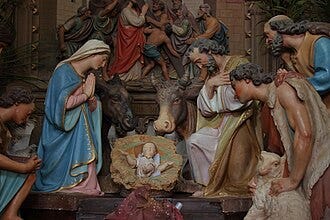
It’s no wonder Protestants can warm up to Mary around Christmastime, but during the rest of the year many suspect Catholics and Orthodox are overdoing it, treating Mary as if she were an extra member of the Trinity.
Having had lots of conversations about this, I know they simply don’t understand what we feel for her. We feel love and admiration for her, just as Protestants might feel toward St. Paul. But we feel more affection for her than we do for St. Paul, because Jesus said she is our mother (“Behold your mother!” John 19:27). We know what a mother’s love is like. That’s why, even when it’s not Christmas, we love her and take her for our companion, just as we do other prayer partners in heaven and on earth.
But we don’t worship her. We love her and ask her to pray for us, but we don’t worship her. That’s very clear on our side of the line, but it seems like Protestants either can’t grasp what we’re saying, or they simply don’t believe us.
Today I ran across this helpful passage in St. Ambrose’s On the Holy Spirit. In affirming the divinity of the Holy Spirit, he says that we rightly adore and worship him just as we worship Christ, who was born of the Holy Spirit. We worship him, but we do not worship to the Virgin Mary. God dwelt in her as if in a temple, but that doesn’t make her divine. “Mary was the temple of God, not the God of the temple.”
[W]ithout doubt, the Holy Spirit…is to be adored, since he who according to the flesh was born of the Holy Spirit is adored.
And let no one divert this to the Virgin Mary; Mary was the temple of God, not the God of the temple. And therefore he alone is to be worshipped who was working in his temple. (St. Ambrose, On the Holy Spirit, Book 3, verses 79-80)
Following up on the theme of unexpected things, elderly ears can create some strange alternative realities.
We were sitting outside by the bonfire in the late afternoon, and the cicadas in the trees were going crazy, so maybe the audio environment was not the best. And I admit all three of us are in our 70s.

Our friend was talking about a trip he was taking with his wife. “And while we’re there, we’ll go to a performance of Tosca.”
Me: “Uh…Kafka?”
Dear husband: “Costco?”
Thank you for that beautiful prayer! I am going to copy it out and carry it with me. It really sums up the things I most need to keep in mind, my persistent underestimation of my sins.
Just a sympathetic note on hearing. I'm 81, with hearing aids, but any external noise makes it very difficult to hear properly 🥴